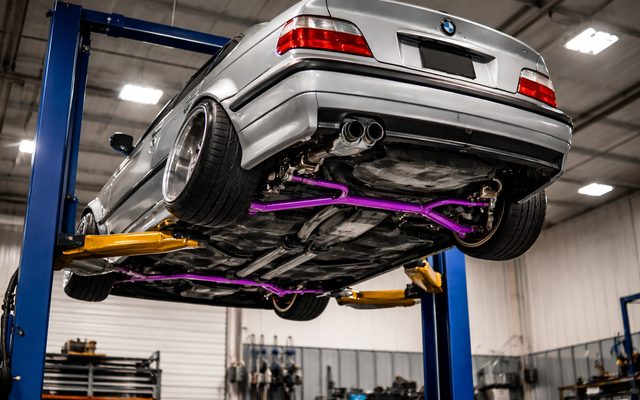
Inside the intensely competitive realm of modern professional sliding, success is no longer solely a function of raw horsepower or pilot courage. Rather, it has evolved into a complex engineering challenge which requires a meticulous blend of selecting a inherently capable vehicle platform, arming it with the highest-quality drift-spec components, and, most importantly, understanding its live behavior on the course through advanced vehicle dynamics analysis tools. This comprehensive guide functions as your master plan starting from the initial concept of a drift build all the way to the last telemetry-optimized refinements that elevate a powerful car into a consistent winner. We will delve deep into the art and science of vehicle alignment optimization, demonstrating how a modern drift tuning app like precise measurement hardware removes assumptions and delivers exceptional insight into your chassis's real-world performance.
The cornerstone of any exceptional drift machine is, without question, the base vehicle itself. Several cars have attained iconic reputation within the global oversteer scene due to their built-in weight distribution, robust construction, and the enormous availability of performance parts available. Picking the optimal car is the initial and most crucial decision a enthusiast will make. To illustrate, the the E36 generation BMW is widely regarded as perhaps the the best all-around drift platforms of all time. Its almost ideal balanced front-to-rear weight, combined with a RWD configuration and extremely reliable inline-six motors, creates a car that is simultaneously accessible for newcomers and incredibly effective in the control of a expert competitor. The evolution of this philosophy, the BMW E46 platform, refines these qualities with a even more sophisticated structure, wider stance for improved high-speed stability, and yet more steering angle as standard from the factory. A distinct powerful contender in the professional arena is the Corvette C6.
This V8-powered sports car introduces a distinctive combination of benefits to the sliding world, including a light aluminium structure, a transaxle-style transaxle that contributes to an ideal weight distribution, and the immense thrust of a big GM LS engine. This combination makes it an utter force on track, able of starting and sustaining extended drifts with relatively effortless deployment of acceleration. For those looking for exceptional performance per dollar, the 350Z model Nissan rises above as a prime candidate. It arrives from the manufacturer with a stiff platform, a decent factory limited-slip differential, and the free-revving VQ35DE engine that offers plenty of horsepower and torque for practicing and moving up in the sport. Its follow-up, the Nissan 370Z, presents more refinements in structural rigidity, handling precision, and outright engine power, establishing its status as a favorite choice among competitive competitors. Other historic cars that merit attention are the agile rotary-powered FC generation RX-7, the ever-present Nissan S13, the torque-rich Ford Mustang SN95, the more recent E90 3 Series, and the tiny yet unbelievably playful and forgiving Mazda Miata. Each of these platforms gives a unique palette of attributes, complexities, and possibilities, but they all possess the basic elements essential to serve as a serious drift machine.
However, choosing the correct chassis is merely the beginning. To access the complete performance of any of these vehicles, substantial modifications to the steering and chassis control systems are utterly mandatory. This is where the world of specialist aftermarket components becomes critical focus. The single most game-changing modification for a dedicated drift car is the integration of a drift-spec steering angle kit. These sophisticated assemblies, like those developed by performance brands like SLR Speed, are designed to dramatically enhance the vehicle's possible turning lock. A standard street car is highly limited in how far its tires can rotate, a safety limitation for on-road operation. In sliding, conversely, maximum steering input is continuously required to control and maintain a angle. An angle kit exchanges the factory hubs, rod ends, and often A-arms with parts that allow the steered wheels to achieve degrees of turn over 70 or even 80 °, versus a typical factory setting of around 40 to 50 degs.
This vastly expanded capability provides the pilot with significantly more command during a slide, making it far simpler to begin a oversteer moment, sustain it through a long turn, and switch fluidly from one side to another. The contrast in controllability is truly revolutionary. Paired with a properly selected steering kit is the just as vital enhancement to the vehicle's suspension. Store-bought or even premium road adjustable suspension are just not engineered for the particular and harsh needs of sliding. A purpose-built system of suspension units is of utmost importance. These engineered coilovers feature custom damping rates and spring stiffness that are tuned for the rapid weight transfer that is characteristic of drifting. When a driver begins a angle, the car's inertia is shifted violently to the outer of the corner. Proper performance dampers manage this shift in a consistent way, allowing the chassis to find its balance promptly and providing the driver accurate feel through the steering wheel and cockpit. They additionally enable exact setting of ride height, damping rate, and corner weighting, which are all fundamental aspects of fine-tuning the chassis's handling to a particular track or competition style. As a system, a precision-engineered angle modification system and a expertly specified pair of competition suspension units form the core mechanical base upon which all subsequent optimization is based.
Once the core components is fitted, the next essential phase in the project is the detailed adjustment of the car's wheel angles. This is the realm of chassis dynamics adjustment, a process that can appear overwhelmingly complex to the beginner but is, in reality, the secret to turning a set of fast components into a harmonious and controllable whole. The most debated element of tuning for oversteer is definitely camber. Camber is the angle of the wheel compared to the vertical plane when observed from the front-on of the vehicle. When the top edge of the tire is tilted towards the car, this is referred to as inward tilt. For sliding, inward-leaning wheels on the steering wheels is universally applied and is considered essential. The logic is intrinsically tied to vehicle dynamics.
When a chassis is going around a bend at limit sideways angles, the frame tilts towards the outer of the bend. This lean makes the outer front wheel to diminish its ideal footprint with the tarmac. By introducing negative camber, the wheel is pre-angled to counteract this lean. As the car leans into the corner, the outside front tire flattens out with the track, maximizing its grip at the exact moment when it is absolutely essential for directional command. Commonly, front axle camber settings for a competition drift machine vary from approximately -3 degrees to as extreme as -5 degrees or even beyond, based on the details of the chassis geometry, compound selection, and driver feel. The back wheels also employ inward tilt, but the angles are generally less and less aggressive car suspension tuning than the front. Overly aggressive inward lean at the rear can result in the chassis overly loose and hard to manage on acceleration input, as it diminishes the effective grip area of the driving tires during straight-line acceleration. Therefore, rear angles are frequently in the ballpark of -1 degree to -3 degrees, achieving vehicle dynamics tool a precise equilibrium between providing sufficient cornering traction to aid in entering and maintaining the angle while also maintaining effective hook-up for exiting the turn. Camber is merely one element of the more complex suspension geometry picture, which also encompasses toe, caster angle, and bump steer adjustment.
Toe setting describes the angle of the wheels when looked at from above. Toe-in means the front edges of the tires are nearer together than the trailing edges, while outward toe means the converse. For drifting, a small amount of front negative toe is often employed to improve the initial response directional feel, making the vehicle feel more nimble and ready to begin a drift. Rear toe setting is generally set to zero or a extremely minute amount of toe-in to foster straight-line stability under power. self-centering is the longitudinal or rearward inclination of the steering axis when viewed from the side of the chassis. More caster angle increases steering feel and high-velocity solidity, and it furthermore adds to camber increase during steering, which is extremely useful. Setting these parameters is a intricate interaction where a adjustment to one parameter can and will affect the others. The old-school process for dialing in a chassis's suspension geometry for sliding has for a long time been a tedious process of trial and error. A driver or team would apply a change based on intuition, test the chassis on track, depend on the pilot's personal perception and impressions, and then make another adjustment. This cycle would repeat over and over until the car felt "right" or the available track session was exhausted. This approach is not just exceptionally wasteful in terms of hours and resources, but it is also inherently inaccurate.
Human sensation is a famously unreliable measurement tool, colored by countless elements such as tiredness, changing track grip levels, ambient heat, and simply the focus of the driver on that specific run. What feels "tail-happy" on one lap might feel "pushing" on the following pass, leading to contradictory information and frustrating changes. This age-old limitation in chassis setup is precisely where contemporary technology has intervened to transform the methodology.
The advent and adoption of advanced drift telemetry software has introduced a completely new paradigm for tuning and optimizing professional drift machines. These systems, represented by groundbreaking products like data acquisition tools, operate by actively recording the real-time physical movement of the chassis as it is operated on the circuit. In contrast to depending on personal impression, these systems collect objective data on essential parameters such as damper compression and extension, individual tire rotation, G-force loading, wheel angle, and throttle and brake position. This collected telemetry is then interpreted by powerful algorithms that can graph and analyze the information in a actionable manner. For the first time, tuners and teams can observe exactly what the chassis is doing at every moment of a drift. This function transforms the entire chassis setup workflow. Imagine the specific goal of setting the front negative camber for a specific vehicle. Instead of introducing a adjustment from -3 degrees to -3.5 degrees and then driving multiple laps to try and "sense" a difference, a telemetry system can give instant and definitive feedback. The application can indicate graphically how the wheel's loading is behaving during the most important moments of a drift: initiation, sustain, and changing direction. It can demonstrate if the present camber setting is enabling the loaded tire to maintain optimal grip or if the compound is overloaded on its outer edge.
The software can then make empirical advice for modification. Perhaps the data shows that the tire is still stressing its sidewall at -3.5 degrees of negative camber, suggesting that an increase to angle, say -4 degrees, might be beneficial. On the other hand, the data might reveal that the tread is not coming up to optimal operating temp or that the inside edge is degrading unevenly, which could suggest that there is too much negative camber and a slight reduction back to -3.2 degrees would be more optimal. This degree of accuracy and practical insight was literally unattainable in the time of solely seat-of-the-pants adjustment.
The benefit of employing a comprehensive vehicle dynamics tool extends well beyond only dialing in alignment. It functions as an invaluable suspension tuning guide that is specific to your exact vehicle. When setting the rebound and compression settings on your adjustable dampers, rather than using vague guidelines or copying another team's numbers, you can utilize the telemetry to see how the chassis is behaving in response to your adjustments. The application can graph the damper movement data over a lap, revealing if the dampers are controlling the chassis motion optimally or if they are permitting the chassis to bounce excessively after a flick. It can aid in identifying issues like excessive compression or excessive extension, permitting you to apply educated choices to preload settings, rebound/compression values, or stance. This methodology applies similarly to the detailed art of suspension geometry optimization. Beyond camber, the system can give insight into how adjustments to toe and caster angle are impacting the car's stability during various maneuvers of a slide. For instance, it can help you to ascertain the optimal amount of front axle toe-out for your particular steering setup and piloting approach by showing the quickness of turn-in reaction and the stability of the car at lock lock. This transforms the system an incredibly powerful performance optimization handbook that is actively calibrated by the actual performance of your personal chassis on the tarmac. It elevates the entire process from a dark art into a repeatable engineering exercise.
Moreover, the value of a platform like modern telemetry is in no way confined to experienced teams with large funding. For the club-level competitor, it acts as an incredible force multiplier. It effectively provides the builder with the insight of a professional suspension specialist without the corresponding expense. It speeds up the learning curve by providing clear answers to questions that would normally take seasons of experience to understand. A driver can understand how their particular car behaves to specific settings, developing a more intuitive knowledge of car control in the endeavor. It furthermore opens up professional performance tuning principles, enabling every enthusiast with the desire to optimize their vehicle to achieve it in a structured and effective fashion. This is particularly significant in a discipline like sliding, where tuning knowledge has in the past been a highly secretive asset among top drivers. vehicle dynamics tool Now, that power can be in the garage of every dedicated builder.
In summary, the path to engineering and tuning the ideal championship-contending drift car is a comprehensive project that seamlessly combines classic engineering wisdom with cutting-edge telemetry technology. It commences with the wise selection of a legendary chassis, then built upon the installation of essential drift-spec parts like maximum-angle angle modification systems and expertly specified performance suspension units. The build then moves into the precision phase of chassis dynamics adjustment, where values like negative camber, toe, and caster angle are carefully adjusted to suit the vehicle's upgraded geometry and the operator's specific technique. Finally, and what genuinely separates the contemporary process from the old ways, is the use of a sophisticated drift telemetry software. This system removes the approximation and inefficiency of only seat-of-the-pants tuning by delivering empirical, real-time telemetry on how the chassis is really performing. It serves as an indispensable suspension tuning tool, a definitive coilover setup manual, and a master chassis development system. In unison, this integrated philosophy leads to that all component of the competition vehicle—from the selection of the platform to the last tweak on the damper—is optimized for peak competitiveness on the circuit. It represents the full evolution of the sport of drifting, connecting mechanical pilot talent with surgical chassis dynamics to create the perfect competitive machines imaginable.